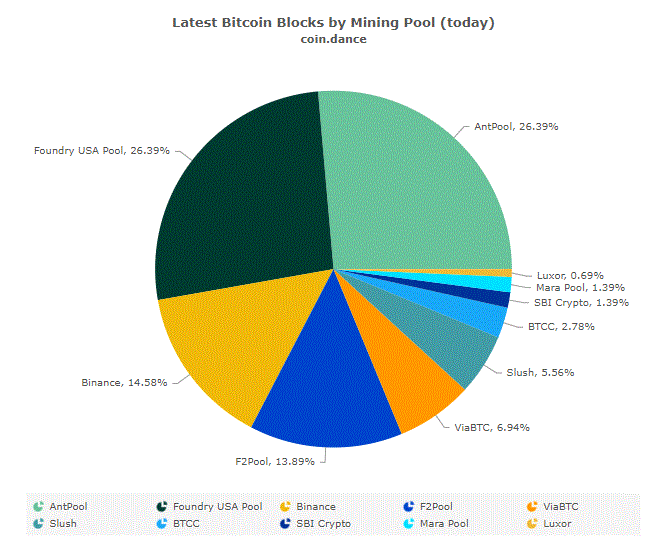
Want to know how well-decentralized blockchain networks are? Unfortunately, you won't find an easy answer to this, as it depends on many details. However, there is one relatively easy method that anyone can use. Try producing your own block. Investigate how much money and effort it would cost. If it is not possible, see if you can participate in the production of the blocks. If the network doesn't allow you to produce your own block or even get rewarded for participating, decentralization will obviously be low. Conversely, if you have a chance to produce your own block, the blockchain will do well with decentralization. Of course, not everyone interested is given the opportunity to create their own block. However, the opportunity to get a reward for participating in the production of a block should be open to as many people as possible. In this article, we will look at the number of block producers in the largest networks. We will have a historical record that we can use to examine in the years to come. Decentralization must grow over time as the number of users grows. If not, the situation must be addressed. TLDR The number of actors that have a majority in the network consensus is important for decentralization. Cardano has more block producers than Bitcoin and Ethereum. Why is the number of block producers important? Multiple entities can participate in a network consensus. Block producers are the most important participants, as they are responsible for selecting transactions to be placed in blocks, or which block to follow in case of a fork. Block producers may even choose not to deliberately add a new block after the last one that was just added. It is possible that the block will be ignored. The reasons may vary, and consensus participants should be able to punish behaviour that is not in line with the principles of decentralization. I assume everyone knows why eliminating the number of single points of failure is important for decentralized networks. The greater the number of block producers, the greater the chance that they won't cooperate with each other on some attack on the network, or be forced to do so by an outsider. In 2019, the Binance exchange was hacked and lost 7000 BTC (40M USD). CZ, CEO of Binance, had plans to get BTC back by reorganizing the Bitcoin blockchain. A blockchain reorganization is, in short, an event which excludes one or more blocks which were previously part of the blockchain. CZ discussed this possibility with several people from the Bitcoin ecosystem. For example, Jihan Wu, who at the time ran the largest bitcoin pool. In the end, they agreed not to reorganize the blockchain. One of the reasons was that it was relatively late and with each additional block the cost of performing this operation grew. It is important to understand that this threat is real and always present. The security of all blockchain networks is built on the assumption that consensus participants will behave honestly. The majority in a network consensus is usually held by a small number of actors. If the majority colludes, is bribed or is coerced into attacking the network, it may succeed. That is why it is so important that the block producers' group is always as large as possible. In this article, we will only deal with the number of block producers. We will not deal with the possibility of delegating or nominating consensus power to block producers. We will make do with the fact that they might not react in time in the event of an attack anyway, or that the largest of them are also involved in the attack. Let's see how many block producers CZ would have to persuade if he wanted, quite hypothetically, to attempt a similar attack again on Cardano, Ethereum and Bitcoin. Cardano Blocks are produced by pools in the Cardano network. To attack this PoS network, it is needed to have control over 51% of the stake. You can see pools through Cexplorer. As you can see, Binance has the largest share of the staking with a share of almost 11%. This is the only entity that has more than a 10% share. The third largest participant has only a 3.4% share. The group named SOLO is composed of single pool operators, i.e. independent block producers. If Binance, as the largest participant in the network consensus, wanted to attack Cardano, CZ would have to convince 22 other major block producers. Ethereum In Ethereum networks, blocks are produced by so-called validators, which need to lock a minimum of 32 ETH when activated. There are 487,000 validators in the Ethereum network. Validators run on consensus clients, of which there are around 6,500. It is not these numbers that are important, but the number of entities that run the validators. You can see the entities through Etherscan. Let’s first have a look at depositors. As you can see, almost 40% of validators are running over staking pools. Exchanges have a 30% share. Staking-as-a-service (SaaS) has a large share in the Ethereum ecosystem. Entities produce blocks on behalf of ETH owners. Ethereum validators have two key pairs: 1) a validator key pair for signing block proposals and attestations, and 2) a second withdrawal key pair that will allow the validator to withdraw and transfer their staked ETH (after the Shanghai hard fork). ETH stakers can leverage SaaS providers while only granting them access to their validator key pair. It allows them to sign block proposals and attestations while preventing them from withdrawing or transferring the staked ETH. While this setup allows ETH owners to maintain custody of their assets, there are embedded trust assumptions that the SaaS provider will maximize rewards and avoid penalties and slashings. In the context of our article, it is important that Saas providers have control over the consensus. Let's take a closer look at the distribution of consensus power. As you can see, exchanges have a strong presence in staking. Coinbase has a 13.3% share, Kraken has a 7.3% share, and Binance has a 6.3% share. Another significant portion, 29.4%, has LIDO. LIDO is Ethereum's liquid staking provider. LIDO consists of more than 30 independent operators, including Figment, Stakefish and others. To attack the Ethereum network it is just needed to have more than 33% stake. The attack would be successful if the 3 largest exchanges and the 3 largest LIDO operators worked together. It is 6 entities in total. Binance is one of them. Bitcoin In the Bitcoin network, blocks are produced by pools. It is similar to the Cardano network. To attack this PoW network, it is needed to have control over 51% of the hash rate. You can see the pools through Coindance. As you can see, the two pools AntPool and Foundry USA have the same share of 26.39% hash rate. Depending on randomness, occasionally one of these pools will get above 30% share. If these two pools worked together, they would have a majority in the network. Binance has a 14.5% share in the network. If CZ persuaded only one of the pools to cooperate, they would only have about a 40% hash rate share. So CZ would have to convince both of the two largest pools to cooperate, or only one of them plus other smaller pools (F2Pool with a 14% share). How to increase the number of block producers? To make blockchain networks more decentralized, the consensus share of the current largest entities must decrease and the opportunity for producing your own block must increase. Neither is easy. The world naturally gravitates towards centralisation. Money generates power. Power generates more money. The Cardano protocol contains parameters through which decentralization can be influenced to some extent. For example, if the number of parameters defining the optimal number of pools is increased from 500 to 1000, the saturation point is reduced. This would essentially mean that it would be cheaper to run a new pool. But you can't reduce the share of the consensual power to the current whales like Binance. To run a validator and produce a block in the Ethereum network, it is needed to have 32 ETH ($42,000 USD). That's certainly less than what you would need to create a Cardano pool. In the Cardano network, it is impossible for an individual with a small number of ADAs to create their own block. Cardano, on the other hand, uses the concept of delegating coins to a pool, so the option to participate in block production and retain control over the choice is available. Pools in the Ethereum ecosystem may one day function very similarly. Let’s add that similar to Cardano, it will be difficult to get rid of the current strong players. The Bitcoin network is the oldest and perhaps because of this, control over block production has been centralized into 2 large pools that each have more than a 25% share of the hash rate and together have more than a 50% share. The Bitcoin protocol does not support pools and therefore has no control over them through incentives. The entire block reward goes to whoever mines the block. Bitcoin basically doesn't even know that miners are banding together in pools. Interestingly, in 2019 there were still 5 to 6 pools that had more than 10% share (the largest around 20%). Within 3 years the situation has deteriorated significantly. I can't imagine one pool having more than 50% share. Conclusion As mentioned above, measuring decentralization is complex. The number of block producers is an important figure in the context of attacks where producers cooperate, but it is not the only figure that is significant. CZ would not succeed today with a similar demand for blockchain reorganization and probably would not even attempt it. However, on the level of theory, such an attack is real and we should at least be informed about it. The article is a sort of historical snapshot of the decentralization at the end of 2022. We will see how the decentralization of Cardano, Ethereum and Bitcoin will evolve in the years to come.