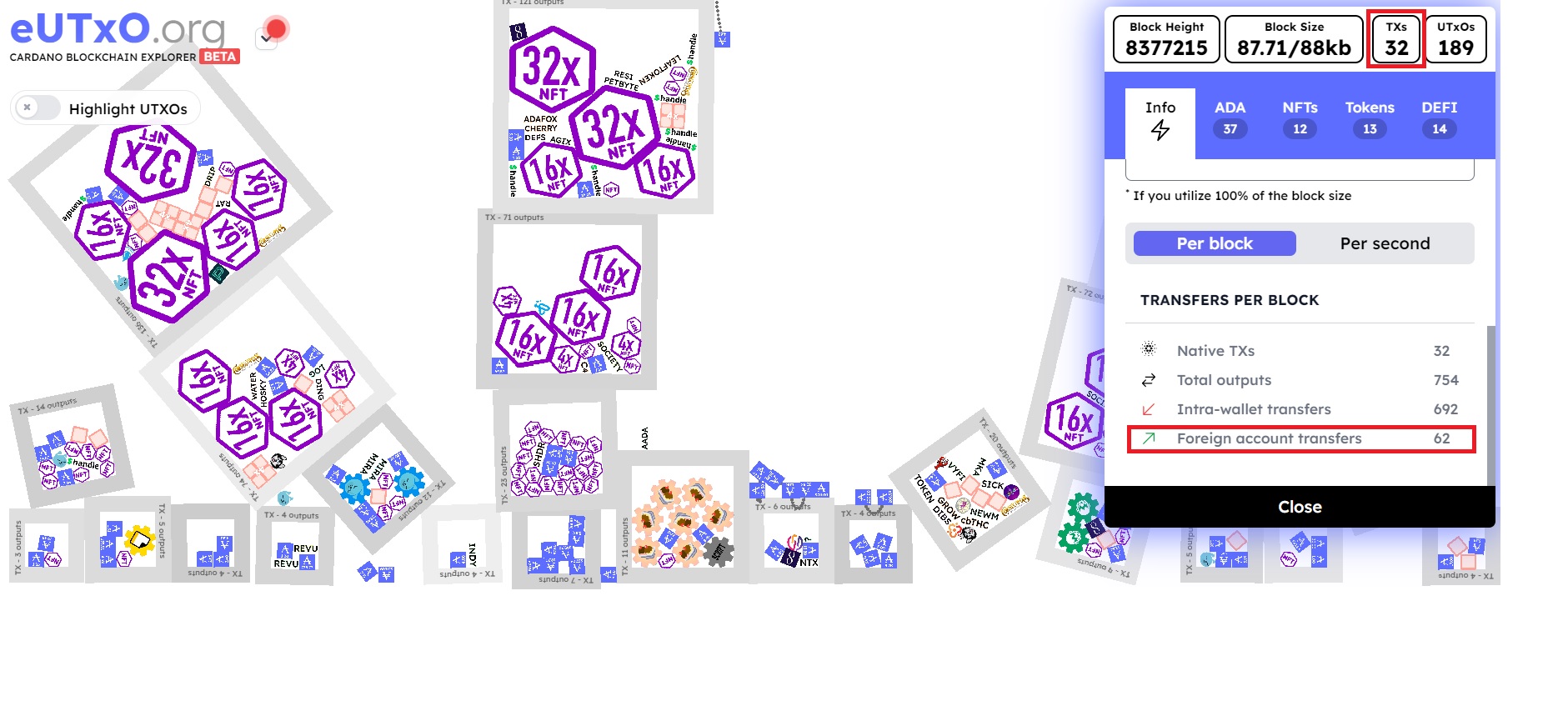
TPS (Transactions Per Second) is a measure of the number of transactions a network can process in one second. TPS can tell us how many people are using or can use the network at any given time. The TPS metric assumes that one transaction transfers value between one sender and one receiver. However, it has one catch. This assumption is not valid for the blockchain industry. Cardano and many other networks can send multiple assets to multiple receivers in a single transaction. Such transactions are commonly seen in DEXs, for example. Centralized exchanges can submit a single transaction for all withdrawals at a given time. Let's explain why the TPS metric should be used very carefully and should rather be replaced in the case of blockchain networks. TLDR Transactions consisting of many financial operations are cheaper and smaller in size. The TPS metric is unable to provide data on the number of recipients who received funds through the transaction. It would be better to measure something like the number of recipient addresses per second. In the future, it will be more efficient for blockchain networks to transmit large transactions with multiple operations than single transactions. Why is TPS an inaccurate metric? TPS is commonly used to assess the performance and scalability of computer systems, particularly those that process large amounts of financial transactions, such as payment systems, exchanges, and banks. TPS is suitable for mainstream financial systems as transactions usually take place between two participants with a bank account. As we said in the introduction, blockchain networks make it possible to send funds to multiple recipients in a single transaction. The reason is higher efficiency. Block space is expensive and it is economically advantageous to combine multiple financial operations into one large transaction. Let's take an example. A usual simple Cardano transaction may be say from 0.2kB to 0.5 kB in size and the common fee is 0.17 ADA. It depends on the number of inputs and outputs. In one of our articles, we wrote about a big transaction that looked like this. A single Cardano transaction for multiple users contained funds for 220 users. It was 14kB in size (took up 17% of the block) and the fee was 0.8 ADA. Imagine if a sender sent 220 regular transactions instead of a single large one. It is possible that transactions would occupy more than half the block and the sender would pay 40 ADA. As you can see, it is more economically viable for a sender to create one large transaction with multiple recipients than create multiple simple transactions. It is also advantageous from the point of view of the scalability of the Cardano network since one large transaction saves space for the other transactions in the block. Theoretically, a single transaction occupying the entire block could send funds to as many as 1300 recipients. However, it would not be fair for one sender to occupy the entire block. Suppose someone wanted to measure the throughput of the Cardano network blindly based on TPS and would see an average of 20 transactions in blocks. Cardano produces blocks at 20-second intervals. An observer could declare that Cardano is doing 1 TPS. Realistically, in almost every block you will find transactions containing multiple financial operations. The TPS metric fails because the number of people who received funds is much higher. We will show this with an example below. A different metric must emerge for the blockchain industry TPS is not a suitable metric for the blockchain industry and should be replaced by something else. TPS is only suitable for systems where a single transaction contains a single asset and goes from a single sender to a single receiver. Cardano allows multiple assets to be sent in a single transaction. If the sender wants to send ADA, HOSKY, and NFT to the receiver, a single transaction is sufficient. A conventional financial system would probably need multiple transactions in different systems to do something similar. As we have described, Cardano allows you to create a transaction with multiple recipients. Recipients can receive multiple assets. If the goal is to measure network throughput, i.e. the number of users served, this must be taken into account. If you analyze the Cardano block, you will find that very often the number of value transfers from wallets to wallets is greater than the number of transactions. In other words, the number of senders may be significantly smaller than the number of recipients. The number of recipients is more important than the number of transactions. It would be better to measure something like the number of recipient addresses per second. Or try to analyze the recipients' addresses to see how many unique wallets the transaction transfers funds to. This would be much more accurate since it can be assumed that the recipient of an asset has not provided the sender with 2 addresses for the same asset. Ideally, information about assets could be obtained. If the recipient got ADA, HOSKY, and NFT, this could be considered 3 financial transactions. In the image below you can see that the block contained 32 transactions. The TPS metric comes out to 1.6. Note the "Foreign account transfers" figure containing the value 62. This is the number of recipients. The adjusted TPS should therefore be 3.1. Scalability of blockchain networks Blockchain networks will never be able to scale well. Experts agree that the first layers will serve as the main settlement layer. Most transactions with crypto-assets will take place on other networks that will process transactions in parallel with the main chain. With higher adoption, the demand for block space will grow significantly. Blockchain project teams will one day be faced with the question of how to use block space as efficiently as possible. Common transactions between one sender and one recipient can be seen as a waste of precious block space. Once the demand of users to send a single transaction exceeds the capabilities of the blockchain, it is necessary to postpone processing some transactions until later or even discard some of them. So how to use the space in the block as efficiently as possible? Imagine a 10-kilometer highway that can only be used by taxis and buses. This will be analogous to block size and also to single and multiple transactions. Everybody has to keep the same speed. That's analogous to block time. For simplicity, let's assume that buses are always full of passengers. How to get the largest number of people from one end to the other on the highway? In our example, a taxi can only carry one person. The bus can carry 50 people. The bus is 4 times bigger than the taxi. The highway can hold either 1,000 taxis or 250 buses at any one time. A combination of taxis and buses is possible. If only taxis travel on the highway, only 1000 people can travel at any one time. However, if only buses are on it, there could be as many as 12,500 people. If there were 500 taxis and 125 buses on the highway, 6,750 people would travel on it. As you can see, from an efficiency point of view, it is better to have buses on the highway and a minimum of taxis. The same can be said for transactions on the blockchain. It is more efficient to use multiple transactions (buses) than single transactions (taxis). Let's go back to the TPS metric. If an observer had been tasked with measuring the number of vehicles on the highway, he could have calculated an average number of 500. If he didn't distinguish between taxis and buses, he might mistakenly believe that only 500 people are transported on the highway on average. This could only be true if only taxis transported people on the motorway. If an average of 150 buses and 350 taxis transported people on the highway, an average of 7,850 people would travel on the highway. Conclusion There are blockchain transactions that are used for purposes other than transferring value between users. Some networks use large numbers of such transactions for some kind of synchronization. If analytics firms want to measure network throughput and usage in a good way, they need to go more in-depth and look at the content of transactions. TPS is a misleading metric for the blockchain industry, and for Cardano in particular.