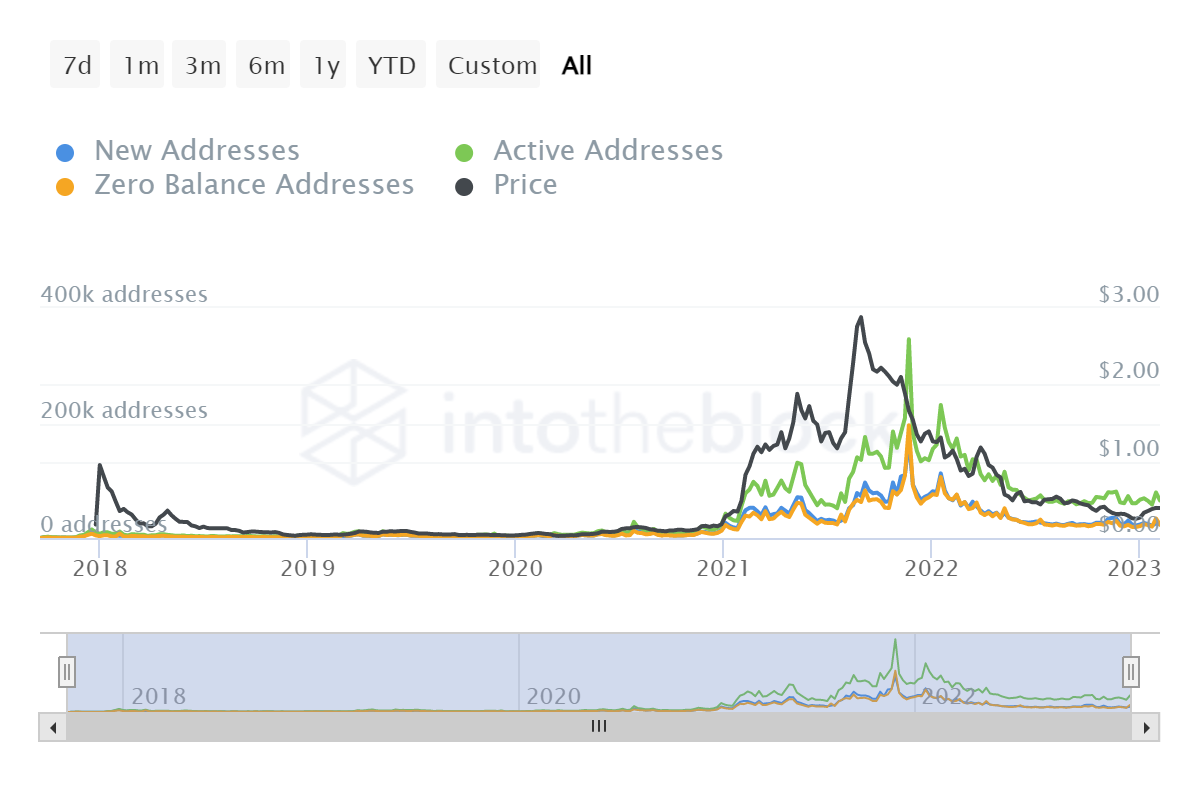
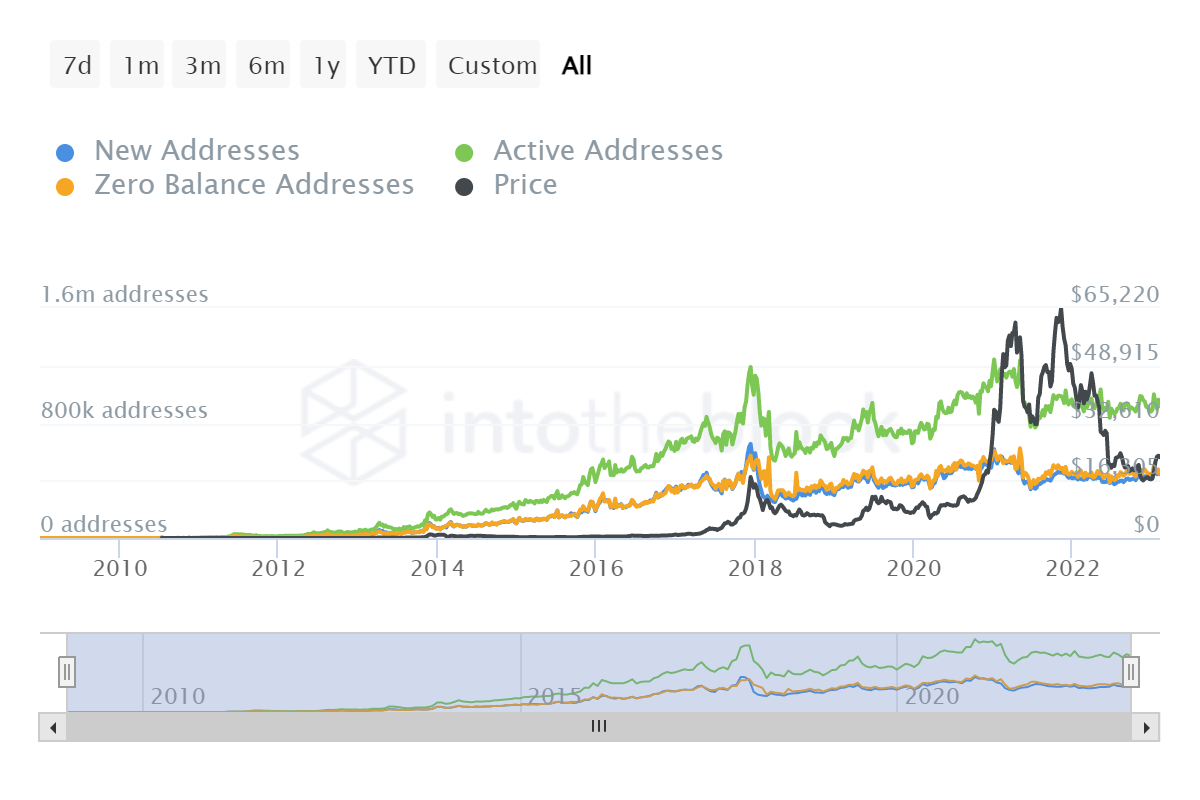
Public blockchain networks have one big advantage when it comes to measuring activity. Thanks to on-chain analytics, we can know exactly how many people have exchanged digital assets with each other over a certain period. Activity on the network is one of the main indicators of the health of the ecosystem. If activity is increasing, it's potentially a good sign and a guarantee that the network is becoming more popular or useful. Let's take a look at how active people are on the Cardano network and compare the numbers to other networks. You'll see that Cardano is definitely not a ghost-chain. TLDR An address is considered active as soon as it becomes a direct participant in a confirmed transaction in a given time period. The number of active addresses is probably one of the best statistics when it comes to network health. Roughly 60K people use Cardano every day. That's 10 times less than Ethereum. The biggest wave of Cardano adoption is yet to come, as we can expect many new services to be deployed in 2023 and 2024. What is an active address? For all blockchains, the user needs to generate an address in order to receive digital assets and be later able to send them to another address. Blockchain wallets help users to create an address. Thus, addresses can have one of the following statuses. New addresses, which are empty once generated. Active addresses are those that were used to transfer digital assets during the observation period. Inactive addresses are those that contain digital assets but have not been used to interact with another address for a longer period. Remember, that the number of addresses, regardless of their status, cannot indicate the number of unique users as there are no hard limits to the number of crypto wallets or addresses an individual can create and operate. One user can generate thousands of addresses, or send a digital asset over and over between 2 addresses. Therefore, the number of active addresses is probably one of the best statistics when it comes to network health. An address is considered active as soon as it becomes a direct participant in a successful transaction. The address can be used by either a sender or a recipient. Although a user can send tokens from one address to another address and be the owner of both, such transactions will be minimal. Most transactions are usually between two participants. The number of active addresses represents the total number of active users on the network in a given period. It is possible to observe the activity daily, weekly or monthly. However, a particular address is counted just once over any timeframe, even if it has been an active participant in two or more transactions. The statistic measures the number of unique users and does not take into account the activity of individuals. In other words, the number of transactions is not important. Active addresses are gathered based on on-chain analysis of confirmed transactions. Transactions are searched for unique addresses of recipients and recipients in a given time period. Active address data usually contains 3 entries. The total number of active addresses, the number of addresses used for sending, and the number of addresses used for receiving. If you look at the number of active addresses you will see that the total active address is for example 65K, the number of addresses used for sending is 52K and the number of addresses for receiving is 55K. From this information, you cannot tell exactly how many people used the network, as one sender could have used multiple addresses with assets. In the following, for simplicity, we will consider the total daily addresses as the number of users who used the network. This is imprecise, but for the purposes of this article, it is sufficient. It is important to note that the number of active addresses is a figure linked to the use of the network and says nothing about the number of coin holders. People can buy coins once and then not use the network for several years. The number of coin holders will thus be several times higher than the number of daily users. In the case of the Cardano network, for example, we know that approximately 1.2M people stake ADA. The difference between daily network users and stakers is about 20 times. How many people use Cardano and other blockchains? People were most active on the Cardano network from mid-2021 to mid-2022. During this time period, roughly 100K to 150K people per day (active addresses) used the network. The peak was 350K per day. At the time of writing, a bear market is underway. Cardano is used by roughly 60K to 70K people per day. Below, we take a look at the daily activity on the Bitcoin and Ethereum networks. Cardano is the youngest project of the trio we will be following. The growth of activity on the Cardano network correlates with the time when key network upgrades such as native asset support and the change of network consensus to PoS were introduced. Interest in using the network in a bear market is declining. Over the course of the year, we can see usage drop by about half. The DJED stablecoin was launched in January and activity is starting to pick up slightly. The launch of other stablecoins and new DeFi services can be expected to maintain or even increase user activity. We anticipate that daily activity will not drop below 50K. Depending on market sentiment Cardano may reach up to 100K active addresses per day within a year. From 2021 to the present, we can observe roughly 900K active addresses in the Bitcoin network every day. Between 2016 and 2017, the number of active addresses jumped from 500K to 650K. The maximum number of users could be observed at the end of 2018 and 2021 when there were 1.1M users. We can say that in the last 5 years, i.e. since 2017, the number of active addresses has only increased by about a third. Bitcoin usage is growing only slowly. This will to some extent be due to people using other (faster) networks more for BTC transfers. In the case of Ethereum, we can currently observe roughly 500K active addresses per day. At the end of 2017, the peak of ICO mania, we saw a similar number. Subsequently, during the crypto winter, the number of users dropped by about half. We can say that Ethereum has had a very similar number of daily users from 2017 to the present. When network activity is higher, we can observe up to 800K active addresses. It must be said that blocks are often full and Ethereum cannot process multiple transactions. Bitcoin blocks are usually more than half empty. Let's take a look at the number of addresses where some balance is located. Cardano has 4.3M addresses with some ADA coins. Bitcoin has 42M addresses with BTC and Ethereum 87M addresses with ETH. As you can see, even here the difference is not dramatic. Comparison of the number of active addresses Bitcoin needed roughly two years to grow from 0 to 10K active addresses. The road to 100K took another 2 years. It happened in 2013. Ethereum took about a year to go from 0 to 10K and another year to get to 100K active addresses. Ethereum was lucky that the ICO mania took place in the year when the Bitcoin halving craze was at its peak. It took Cardano 4 months to go from 0 to 10K active addresses. It was also due to the fact that it was the end of 2018. It was followed by a crypto winter in which the number of users plummeted. That changed in 2020 when the number of users rose above 10K daily and hasn't dropped below that since. The threshold of 100K active addresses per day was first surpassed in 2021. Each blockchain has unique conditions in terms of market entry. Cardano was lucky to get to 10K active users quickly, but due to the crypto winter, it took a relatively long time to get to 100K. At the moment, Bitcoin is used by roughly 15 times more people than Cardano. Ethereum is used by 10 times more people than Cardano. On average, 1 person on the planet uses Cardano every second. The difference between Cardano and the two described blockchains is only one order of magnitude. It is unrealistic to expect the younger project to quickly rise to the level of those that dominate. It can take several years to catch up or overcome the network effect. This is a relatively good result for Cardano considering it is a smart contract platform that is not just an EVM copy. The developers needed some time to learn how to use the platform to create applications. Documentation and development tools had to be created. Many tools are still evolving and the situation could be a bit better according to some developers. The biggest wave of Cardano adoption is yet to come, as we can expect many new services to be deployed in 2023 and 2024. Stablecoins have emerged relatively recently and have the potential to double the number of active addresses within a year. Stablecoin USDT (Tether) is used daily by 50K-100K people. USDC is used by roughly 30K people a day. Stablecoins make up a significant portion of people's activity. Conclusion It is important to note that these projects have different missions. The difference is mainly between Bitcoin and smart contract platforms. Bitcoin is not suitable for issuing tokens and does not have DeFi services. There is nothing stopping Bitcoin users from using Cardano and Ethereum. This is probably happening, so as the number of Bitcoin owners grows, the number of people using DeFi will grow. Not every bitcoiner will be an enthusiastic fan of DeFi, but a significant portion will certainly use other networks if it makes economic sense. The rise of second-layer solutions is to be expected. With some exaggeration, it can be said that a successful project will only be one that has a reliable second layer. The second layers must not only scale well, but they must be programmable (like the first layer) and have seamless user-friendliness. Within a few years, there may be more users on the second layers than on the first layers.