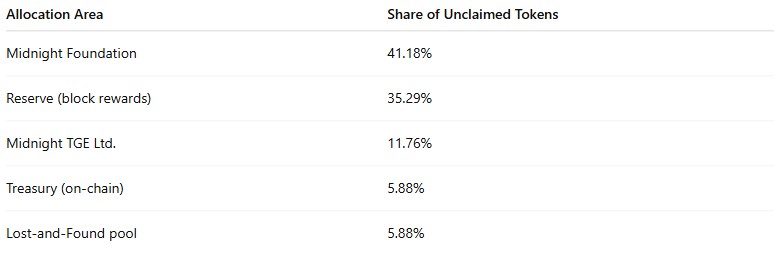
Midnight is a new privacy-focused blockchain, engineered with a novel tokenomic model that uses two core assets: NIGHT and DUST. We’ll break down how these tokens function, how they interact, and how Midnight’s economics incentivize a sustainable, privacy-preserving network. Midnight’s tokenomics are designed for fair access, predictable costs, and robust network security. Let’s explore the properties of NIGHT and DUST, and key aspects of this dual-token system. NIGHT: Midnight’s Utility Token NIGHT is the native utility token of Midnight and the engine of its economy. It has a fixed supply of 24 billion tokens, all minted on the Cardano blockchain, which will be mirrored on the Midnight network upon mainnet launch in its genesis block. Unlike typical gas tokens, NIGHT itself is not spent to pay transaction fees (it’s non-expendable for fees). Instead, its primary role is to continually generate DUST, the resource used for transaction fees. In essence, holding NIGHT gives you the capacity to use the network. Key properties of NIGHT include: Divisibility: 1 NIGHT is divisible into one million subunits called STARs (for fine-grained accounting). Transferability: NIGHT can be freely transferred, traded on exchanges, and even wrapped or bridged to other networks if needed. Unshielded Transparency: Transactions involving NIGHT are public and unshielded – all transfers are recorded on-chain with visible addresses, amounts, and metadata. Not Gas, Not Burned: Because fees are paid in DUST, you do not spend or burn NIGHT to use Midnight. Your NIGHT balance remains intact when transacting; only the generated DUST is consumed for fees. This design avoids the classic trade-off of depleting your utility tokens for gas. Disinflationary Supply: NIGHT’s full 24 billion supply is minted initially, but not all circulates at once. A large portion will be held in a Reserve to be released as block rewards. As these rewards are dispensed, the circulating supply grows. Crucially, the rate of new circulation slows down over time, approaching zero inflation once all tokens are released. In other words, block rewards taper off, making NIGHT’s supply curve disinflationary. No new tokens will ever be minted beyond the 24 billion. Governance and Utility: Beyond generating DUST, NIGHT is envisioned to play roles in on-chain governance and ecosystem incentives. NIGHT thus acts as both the power source of the network through DUST generation and the stake that aligns user incentives through governance rights and rewards. Holding NIGHT essentially grants you perpetual access to Midnight’s services and a say in its future, without having to constantly spend your tokens for fees. The question of long-term incentives remains open. Once the Reserve is fully distributed and no further NIGHT can be minted, block producers will need a new compensation mechanism to maintain network security and participation. DUST: The Renewable Network Resource DUST is Midnight’s transactional resource, a sort of “fuel” for running private transactions and smart contracts on the network. Unlike typical gas or fee tokens, DUST is not acquired by buying or trading in the usual sense – it is continuously generated by holding NIGHT. Think of DUST as a renewable energy that powers the network’s operations. Shielded Privacy DUST is a shielded resource, meaning its usage does not leave a transparent trail. Transactions paid with DUST do not expose metadata like sender or receiver addresses in the way they would if fees were paid with an openly traceable token. This provides “rational privacy” – users get privacy for transactional metadata, without turning the main token (NIGHT) itself into a privacy coin. The separation of NIGHT and DUST ensures that user activity can be private on Midnight while NIGHT remains transparent and compliant. Sole Purpose – Fees The only use of DUST is to pay transaction fees that execute operations on Midnight. You can’t use DUST for anything else. It’s not a general currency or store of value. When you send a transaction or interact with a DApp on Midnight, you spend a certain amount of DUST to cover the computational costs, similar to “gas” on other chains. That DUST is then consumed (burned) by the network upon use. No one profits directly from fee payments; DUST is simply the mechanism to allocate network capacity and prevent abuse. Continuous Generation As long as you hold NIGHT, your tokens will continuously generate DUST in perpetuity. This happens at a rate proportional to your NIGHT holdings – more NIGHT means a higher generation rate of DUST per time unit. In effect, new DUST “accumulates” in a designated DUST balance linked to your NIGHT over time. This property gives users predictable access to network capacity: you know that by holding a certain amount of NIGHT, you can reliably perform a certain number of transactions over time without needing to constantly buy fees. DUST is thus akin to a renewable resource replenishing over time, rather than a finite resource you hoard. Designation and Non-Transferability To start generating DUST, a NIGHT holder must designate a DUST address on the Midnight network where the DUST will accumulate. NIGHT can live on Cardano or Midnight, but DUST will only exist on Midnight. Notably, you can designate any Midnight address – it could be your own or someone else’s. This means a NIGHT holder could generate DUST for another user or application by pointing their NIGHT’s DUST output to that recipient address. However, once DUST is generated to an address, it cannot be transferred between addresses like a normal token. DUST stays in the “tank” (address) it was generated to, until it’s consumed for fees by transactions from that address. You can think of each DUST address like a battery that a particular NIGHT balance is charging up. You can change which battery (address) your NIGHT is charging, but you can’t pour DUST from one battery to another. This design prevents a secondary market for DUST and ensures DUST is always tied to actual network usage, not speculation. Decay Mechanism If the link between a NIGHT token and its DUST address is broken – for example, if you move your NIGHT tokens to a different address or designate a new DUST recipient – any DUST that had been accumulated without the supporting NIGHT will decay and effectively vanish over time. In fact, if you fully transfer your NIGHT away, the previously generated DUST in the old address will drop to zero. This prevents someone from “stockpiling” DUST indefinitely or double-spending the resource by quickly switching generation targets. DUST generation is thus tightly linked to the presence of NIGHT, and DUST cannot act as a store of value on its own. It exists to be used, not saved. Unlimited Supply with Dynamic Availability There is no hard cap on how much DUST can be created over the life of the network, since NIGHT generates it indefinitely, DUST supply is effectively unlimited in total. However, at any given moment, the available DUST in the system is limited by how much NIGHT is locked to generate it and how much of that capacity users are actually utilizing. The network can adjust the minimum DUST required per transaction based on congestion and demand, analogous to how gas price might fluctuate. In high-demand periods, transactions will require more DUST (i.e., your DUST “fuel efficiency” goes down), ensuring that total throughput stays manageable. This dynamic fee adjustment is also a defense against denial-of-service attacks – an attacker would need a very large NIGHT holding to spam the network, and the cost in DUST per spam transaction would rise as they fill the blocks. While you can generate unlimited DUST over time, the rate of generation and cost per transaction will balance the load so the network remains secure and efficient. In practice, if you hold enough NIGHT to continuously produce the needed DUST, you can use Midnight without ever paying fees out of pocket. This creates a user experience where participating in the network doesn’t constantly drain your token holdings, encouraging more active use. Meanwhile, those who don’t hold NIGHT can still use Midnight by obtaining DUST indirectly. For example, a DApp or friend with NIGHT might designate DUST to your address, or future marketplaces might facilitate borrowing DUST capacity. This two-tier model with NIGHT and DUST thus separates ownership (NIGHT) from usage (DUST), yielding both economic and privacy benefits. The NIGHT–DUST Relationship The amount of DUST you generate scales linearly with the amount of NIGHT you hold. If you double your NIGHT holdings, you generate DUST twice as fast. This means larger stakeholders can do more transactions per time unit (higher throughput capacity), but everyone gets some baseline of activity. It’s a form of stake-weighted access to network bandwidth. However, unlike a typical Proof-of-Stake mechanism where large stakeholders might also control consensus, here even a small NIGHT holder can participate in using the network – they just have a lower continuous throughput. Because DUST cannot be freely transferred or traded, the only way to get DUST is to either hold NIGHT yourself or have a NIGHT holder allocate some of their generation to you. This ensures that the value of accessing the network always flows back to NIGHT. If demand for network usage grows, that demand translates into demand for NIGHT tokens. This is an elegant economic feedback loop: it could drive NIGHT’s value based on utility demand, while avoiding a secondary market in DUST that could be prone to speculation or hoarding. In effect, having NIGHT is like owning an unlimited transit pass for Midnight – but with a rate limit on how fast you can use it based on how much NIGHT you have. The network can adjust the required DUST per transaction based on overall usage. If too many people try to transact at once and DUST generation can’t keep up, the protocol raises the DUST fee requirement (temporarily) to throttle demand. This is analogous to surge pricing: the “cost” to use the network in terms of DUST goes up, which indirectly means you need more NIGHT (or more time) to generate the needed DUST for each transaction. This dynamic ensures that NIGHT’s DUST generation capability always has a predictable value – i.e., a certain level of network access per token – under varying conditions, promoting operational predictability. Users can plan their usage without worrying about suddenly running out of the ability to pay fees, unlike on networks with volatile gas prices and a single token (where you might need to buy more of the token if fees spike). Initial Distribution of NIGHT Midnight’s NIGHT token has a fixed total supply of 24 billion tokens. This entire supply is created at the start, but not all of it is immediately in circulation. The initial distribution of NIGHT tokens begins with the Glacier airdrop. Midnight’s token distribution model is structured in three distinct phases, each designed to promote fairness, broad accessibility, and decentralized ownership. At the heart of this model is a commitment to allowing up to 100% of the NIGHT supply (24 billion tokens) to be claimed by the public, with no pre-allocated tokens for the team, foundation, or investors at launch. How many tokens ultimately end up in the hands of the community — versus going to reserves and protocol entities — depends entirely on participation in Phase 1. Phase 1: Glacier Drop The Glacier Drop is the initial and primary phase of distribution. It makes the entire NIGHT supply available to eligible users across eight blockchain ecosystems (including Cardano, Bitcoin, Ethereum, and Solana). Participation is based on self-custody holdings of at least $100 worth of native assets at a snapshot date. The claim window lasts 60 days, and claimed tokens unlock gradually over a year. This phase is designed to empower a diverse, multi-chain community. However, if a user doesn’t claim their allocation during this window, their share is considered unclaimed and moved to the next phases and internal allocations. Phase 2: Scavenger Mine Any NIGHT left unclaimed after Phase 1 becomes eligible for redistribution in Phase 2, known as Scavenger Mine. This 30-day event allows new participants to earn NIGHT by solving computational puzzles — a form of proof-of-work challenge. The protocol guarantees that at least 1% of the total supply (240 million NIGHT) will be available in this phase, provided there are enough unclaimed tokens. If less than 1% is unclaimed in Phase 1, the Scavenger Mine allocation is proportionally smaller. Phase 3: Lost-and-Found Phase 3 serves as a final opportunity for users who missed the Glacier Drop. Over a four-year window, eligible users who failed to claim during Phase 1 can still recover their NIGHT, sourced from a dedicated Lost-and-Found pool. This pool is capped at 5.88% of the supply, but again, only if those tokens remain unclaimed after previous phases. How Remaining NIGHT Is Allocated If 100% of NIGHT is claimed in Phase 1, then no tokens are available for Scavenger Mine, Lost-and-Found, or internal protocol allocations. However, the protocol anticipates that many users will not claim their tokens — due to missed deadlines, lost keys, or lack of awareness — and has a dynamic fallback system to allocate unclaimed tokens to other essential areas of the ecosystem. If a portion of the NIGHT supply goes unclaimed, it is redistributed according to the following approximate proportions: Example: Let’s say 60% of NIGHT tokens are claimed in Phase 1 — that’s 14.4 billion tokens. The remaining 9.6 billion unclaimed tokens would be redistributed like this: Step 1 - Allocate to Scavenger Mine: At least 1% of total supply (240M NIGHT), but it can be more. Step 2 - Allocate to Lost-and-Found: 5.88% of total supply = 1.411B NIGHT Step 3 - Distribute the Remaining Unclaimed NIGHT (7.949B) as follows: This structure allows Midnight to balance community-first distribution with long-term sustainability, using actual participation as the determining factor for how much value remains within the protocol’s control. The more users who claim in Phase 1, the more ownership shifts directly to the community. The fewer who claim, the more tokens are retained to fund network operations, incentives, and growth, without needing new token issuance or venture funding. Treasury and Reserve Mechanisms Midnight’s tokenomics include built-in mechanisms for funding future development and distributing block rewards, via an On-Chain Treasury and a Reserve, respectively. Treasury The Treasury is essentially Midnight’s war chest for ecosystem growth. It will be initially funded with about 5.88% of the total NIGHT supply from the genesis block. It will accumulate additional funds over time through a portion of block rewards. The Treasury’s funds are protocol-owned (locked in the ledger) and not controlled by any entity at launch. The plan is to unlock the Treasury for community governance once a robust on-chain governance mechanism is in place. At that point, NIGHT holders could propose and vote on spending Treasury funds for things like development grants, marketing, community initiatives, or other projects that benefit Midnight. Reserve The Reserve is a protocol-managed pool of NIGHT tokens set aside exclusively for block production rewards. As noted earlier, roughly 35% of the total supply is allocated to this Reserve. These tokens start out uncirculated and locked – they are not in the market or in anyone’s wallet. Instead, the protocol dispenses them as rewards to block producers over time. This mechanism is how Midnight incentivizes network security without charging fees in NIGHT or inflating supply beyond 24B. Every block, a certain amount of NIGHT from the Reserve is released as a reward for the block producer and a portion to the Treasury. Because the supply in the Reserve is finite, Midnight’s reward schedule is deflationary: as the Reserve balance shrinks, the absolute reward per block decreases. Block Reward Allocation One innovative aspect is how the block reward is split to encourage network efficiency. Midnight introduces a concept of “block fullness” influencing the reward split. Each block’s reward is divided between the block producer and the Treasury in a ratio that depends on how full (utilized) the block is. If a block is fully packed with transactions (i.e., high utilization of network capacity), the block producer earns a larger share of the reward. If the block has empty space (low utilization), a portion of the reward is diverted to the Treasury instead of all going to the producer. In fact, at launch the protocol sets a “subsidy rate” of 95%, meaning if a block is empty the producer gets only 5% of the base reward and 95% goes to Treasury, whereas a completely full block yields 100% (or close to it) of the reward to the producer. This mechanism incentivizes block producers to include as many transactions as possible and not leave the block half-empty. It essentially rewards efficiency: more network activity directly gives the operator more tokens, while inactivity or low activity benefits the community Treasury. Over time, this could encourage block producers to perhaps share DUST or lower fees to attract transactions, aligning their interests with network adoption. It’s worth noting that no transaction fees (DUST) are paid out to block producers – block producers only earn NIGHT from the Reserve as described. The DUST that users spend for transactions is simply burned to cover the cost. This is unlike many blockchains where miners/validators earn fees from users; in Midnight, validators are paid entirely via the token inflation mechanism. All block rewards come from the pre-allocated Reserve, and fees in DUST operate independently. This separation ensures that the cost of using the network (in DUST) doesn’t directly enrich block producers in an uncontrolled way, which could create perverse incentives or complicate the privacy model. Instead, block producer earnings are predictable and under protocol control, and network usage contributes to the Treasury rather than individual operators, except through the fullness-based mechanism. Conclusion Midnight’s tokenomics present a holistic approach combining technical innovation with economic foresight. By separating value (NIGHT) from utility (DUST), Midnight achieves privacy for transactions and predictability for users. By distributing tokens freely and widely via Glacier Drop, it aims for a genuinely decentralized initial ownership, avoiding insider-heavy allocations. And through Treasury and governance mechanisms, it plans for the long-term growth and self-governance of the network. All these pieces work in tandem, making Midnight a novel economic experiment in the blockchain space: one that strives to be sustainable, private, and fair in its token dynamics. Midnight’s NIGHT and DUST model could very well set a template for future blockchains that seek to balance user experience (no gas hassles), privacy, and incentive alignment.