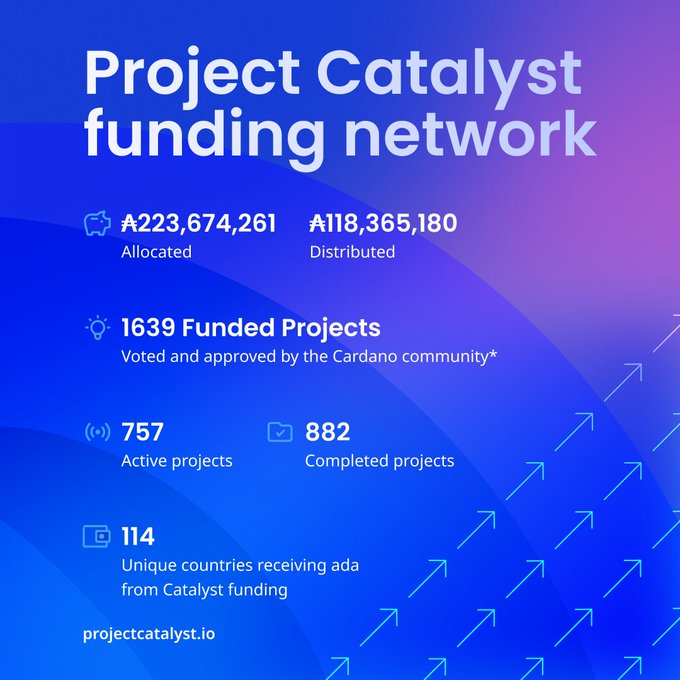
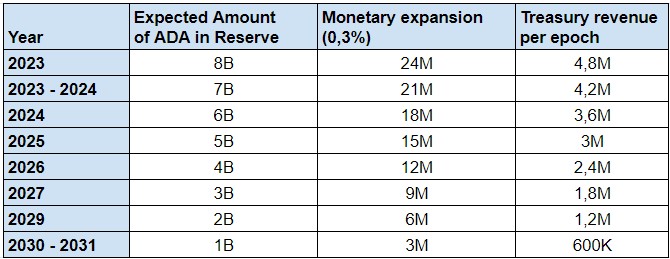
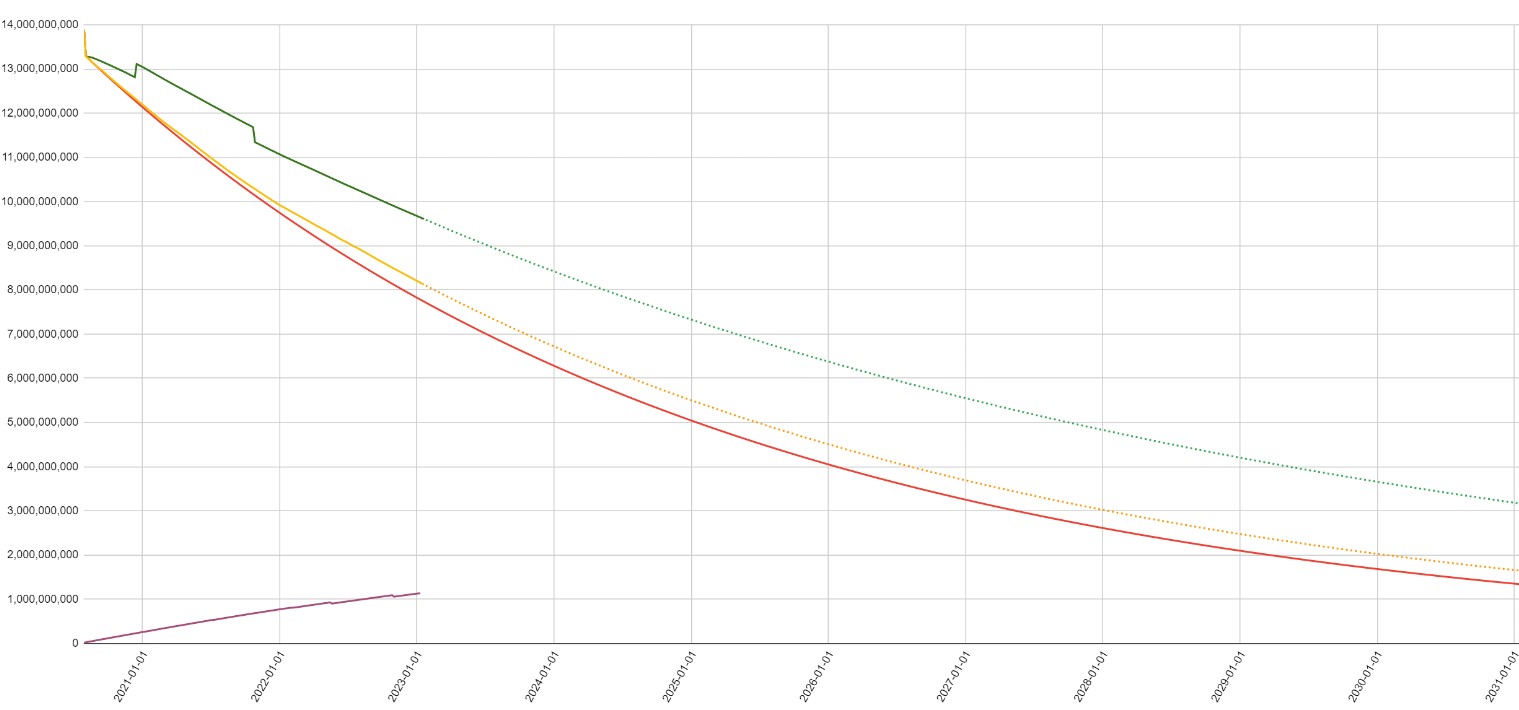
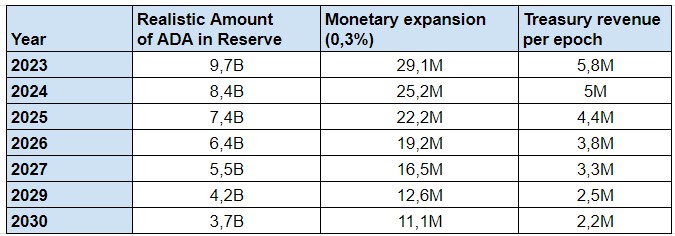
Although the Cardano constitution hasn't been approved yet, there are already suggestions on how to allocate ADA from the treasury and proposals to adjust parameters to boost staking rewards, potentially reducing treasury revenues. Before governance bodies begin authorizing treasury withdrawals, a strategic plan should be established. The community needs clarity on the budget for the coming years. In this article, you'll discover the projected revenues for the treasury in the coming years and examine current expenses. This information is crucial for governance bodies when making decisions about ADA withdrawals from the treasury. The Cardano Treasury Revenue The Cardano treasury holds 1.52 billion ADA, while the reserve contains 7.84 billion ADA. Every 5 days, during the transition between epochs, 20% (parameter T) of collected fees and 0.3% (parameter ρ) from the reserve are added to the treasury. 80% is used to reward pool operators and stakers. The protocol returns a significant portion of ADA from the virtual pot back to the reserve because the conditions for fully paying out staking rewards aren't met. The impact of this will be explained later. Each epoch, Cardano cashes in fees between 30,000 and 90,000 ADA, with around 23.5 million ADA currently being taken from the reserve. About 4.7 million ADAs are deposited into the treasury. The reserve is gradually depleting, resulting in less ADA being transferred to the treasury each epoch. Although an increase in collected transaction fees is anticipated, this has not yet occurred. Most ADAs used for staking rewards and transferred to the treasury still come from the reserve. How Much Can Be Spent From Cardano Treasury Per Year? The sole expenditure from the Cardano treasury is the Catalyst project, with each fund currently receiving a subsidy of 50 million ADA. The pilot Fund1 was launched in the fall of 2020, and the latest is Fund12. On average, 3-4 funds are held annually. If the 50 million ADA subsidy continues, about 200 million ADA will be spent from the treasury in 2025. Across all Catalyst funds, 223 million ADA has been allocated from the treasury to support 1,639 projects. On average, each project receives about 135,000 ADA. It's time to consider how many such projects we aim to support annually. If the protocol parameters remain unchanged, the revenue to the treasury per epoch will follow this pattern. Please note that this is only an estimate. As the reserve depletes over time, the revenue will also gradually decrease. For example, at the start of 2024, the revenue per epoch was 3.6 million ADA. However, by the end of the year, it had decreased to 3 million ADA. Fortunately, the reserve is depleting more slowly (green line) than initially anticipated (red line). Staking rewards are lower, and a portion of the ADA is returned to the reserve each epoch. This now appears to be an advantage. More realistic revenues to the treasury per epoch are projected as follows. This means, that at the start of 2024, the revenue per epoch was 5 million ADA. However, by the end of the year, it will decrease to 4,4 million ADA. In 2025, revenues to the treasury from monetary expansion are projected to be approximately 300 million ADA. By the end of 2025, the revenue will be about 3,8 million ADA per epoch. For transaction fees, we can anticipate a range of 2 million to 10 million ADA. The Cardano community's priority is to fund projects that will boost the amount of collected fees. Fees need to become a more significant part of the treasury's revenue as soon as possible, ideally increasing tenfold over the next five years. However, this won't be technically feasible until Ouroboros Leios is implemented. It's important to avoid having expenses exceed income. Assuming Catalyst continues to manage 4 funds annually or the subsidy per fund increases, we would have roughly 100M ADA remaining for additional expenses. By 2029, it will no longer be feasible to finance Catalyst in the same manner without risking a deficit. I assume that once on-chain governance is established, Catalyst will need to apply for spending approval. The Cardano community might opt to adjust Catalyst's subsidy. An important consideration for ADA-nominated expenses is the market value of the coins in USD. The higher the market value of ADA, the less ADA will be needed to cover, for example, $1 million. If ADA's market value is $0.33, 3 million ADA would need to be withdrawn from the treasury. However, if ADA's market value is $2, only 500,000 ADA would be required to cover the same amount. These are significant differences. People will always convert their costs to USD (or other fiat currency). The higher the market value of ADA, the more projects or ideas can be financed from the treasury. Unfortunately, it is currently impossible to predict the market over the next 5-10 years. The amount of ADA in the treasury should always be a concern for the Cardano community. Conclusion There are considerations to reward DReps. For example, if we were to pay 500 DReps 2,000 ADA per month, it would cost the treasury 12 million ADA annually. That would account for approximately 4% of the annual revenue for 2025. It's important to consider that the revenue from the reserve will diminish each year. We could also consider funding projects that will generate ADA for the treasury upon completion. For instance, we could support DeFi projects or businesses that allocate a portion of their fees not only to their team (and token holders) but also to the Cardano treasury. At least part of the ADA should be used as loans, not necessarily as payments for projects with uncertain impacts on Cardano. By doing this, we can support intriguing projects while increasing the likelihood that some ADA will be returned. It's crucial to remember that the Cardano treasury is not an endless resource, and we must manage it accordingly. Some ADA could potentially be used as collateral to earn a regular yield. Some suggest that the treasury could hold stablecoins or even BTC instead of ADA. However, this would require selling a large amount of ADA to acquire these assets, which wouldn't be favorable for stakers. A better approach might be to leverage the Cardano DeFi ecosystem to find attractive yields, potentially addressing the issue of low liquidity. Higher expenditures could be considered only if collected fees increase. For instance, DReps should be incentivized to make optimal decisions for the ecosystem. As treasury revenue decreases, their rewards might also decrease. Conversely, if the protocol collects more from transaction fees, their rewards could remain stable or even increase. Once on-chain governance is implemented, many teams will seek ADA from the treasury. We may see many seemingly attractive proposals. However, we cannot afford to spend tens of millions of ADA per month. We should definitely avoid paying large sums upfront and instead proceed gradually, based on careful analysis of incremental successes. There are also suggestions to modify the T parameter. At this time, it's certainly not feasible to increase staking rewards by reducing the treasury's revenue. A 20% allocation seems like an absolute minimum. Instead, staking rewards can be enhanced by educating stakers that the protocol favors 500 fully saturated pools. Altering monetary policy is an unacceptable shortcut. Additionally, the Bitcoin ecosystem adheres to the principle of immutable monetary policy. Perhaps we should consider following this approach as well.